阿戈戈铃:历史、作品与在线演奏
阿戈戈铃(Agogo):坚硬本体振动,具有明亮的非整数泛音。
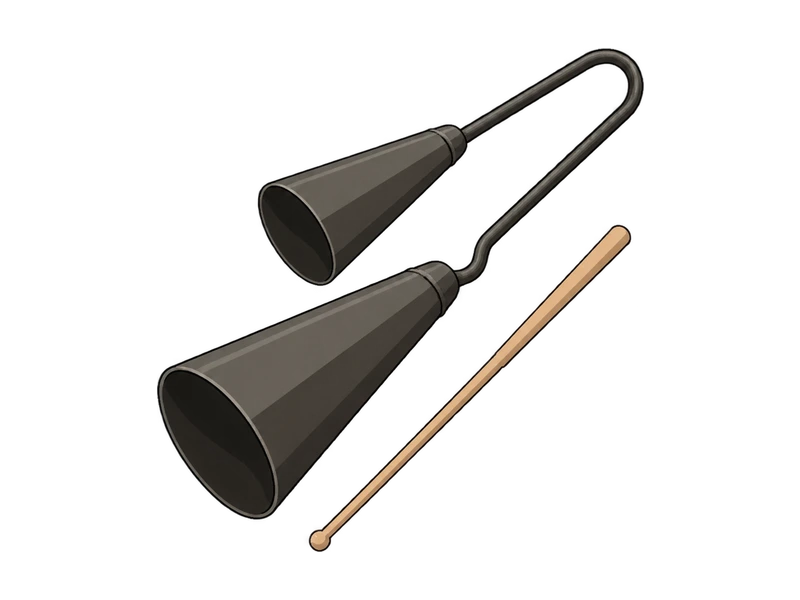
西非 · H-S 111
演奏与应用
坚硬本体振动,具有明亮的非整数泛音。
详见历史原文中的音乐传统与用途。
Overview
An agogô (Yoruba: ['aɡoɡo]) is idiophone bell percussion instrument. With origins in West African music, it is now commonly used in traditional and popular Brazilian music. Agogôs are typically made from two cone-shaped pieces of metal with different pitches.
Etymology
The word agogô is West African in origin. Ágogo is used by the Edo, Idoma, Igala, and Yoruba people of Nigeria to refer to a single or double clapperless bell. A broader category of all types of clapperless bells is referred to by the word òjè, which translates to "iron". The instrument's name and the knowledge of its construction were carried to the Americas by enslaved West Africans.
Construction
Originally built from wrought iron, the agogô is now manufactured from a variety of metals and sizes for different sound qualities. The bells of a metal agogô are constructed from fan-shaped pieces of sheet iron rolled into cones. The two bells are then welded together using a U-shaped piece of metal. Each bell is a different length, which allows a differently pitched note to be produced depending on which bell has been hit. The pitch of the bell is determined by length; longer bells create a lower-frequency sound, while shorter bells are higher-pitched. Another factor determining sound quality is the thickness of the material. Thick-walled bells create less vibration, and thin bells vibrate more easily.
Playing
The agogô is played by gripping the instrument in one hand, so that the handle is in the player's palm. The openings of the bells should face away from the player and the smaller bell should be above the larger one. The bells may be struck by a drumstick or another beater made from either wood or metal.
Nigeria
Drums are a foundational component of Yoruba music, which, in turn, is integral to Yoruba cultural and religious life. The âgogo features prominently in Ìpèsè, a drum ensemble used in Ifá festivals. The ensemble also plays during rituals to appease the gods. Additionally, the âgogo plays a significant role in the Yoruba musical subgenres of Juju, Afro-juju, Apala, Fuji, and others. The instrument is often used by Nigerian performers to bring traditional Yoruba music to a larger audience.
Brazil
Enslaved West Africans were the first to introduce the agogô to Brazil. There, it is used in African-derived religious practices such as Candomblé, as well as to accompany capoeira, an Afro-Brazilian martial art. Along with European instruments, such as the seven-string guitar, and indigenous instruments, such as maracas, the âgogo played a significant role in 1920s choro ensembles. It has also gained a place in samba baterias, a rhythmic component of secular Carnival celebrations. Many Brazilian and Afro-Brazilian popular musicians use the âgogo in their songs, especially to create Afro-Brazilian rhythms and grooves.
资料来源
Wikipedia contributors · CC BY-SA 4.0https://en.wikipedia.org/w/index.php?oldid=1356575093 · 2026-10-05 · 原文节选与分节整理。
SciForu Music · AI-assisted illustration · 图片来源https://jizhiapi.site/v1 · AI-generated illustration; provider terms applyhttps://jizhiapi.site/ · AI 辅助 2D 乐器识别插画,透明 WebP;服务条款适用。
MIMO H-S 分类参考https://www.mimo-international.com/documents/Hornbostel%20Sachs.pdf