革胡:历史、作品与在线演奏
革胡(Gehu):持续摩擦激励,可连续控制力度与音高。
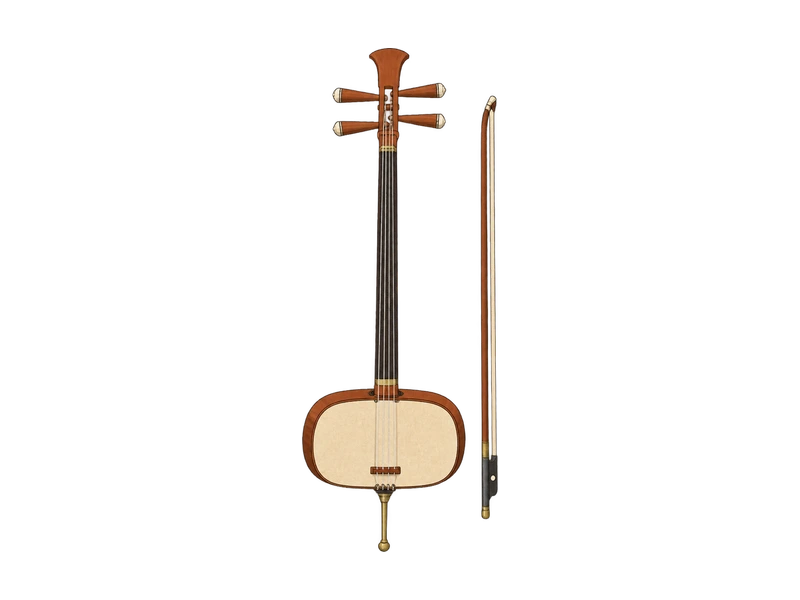
中国 · H-S 321
演奏与应用
持续摩擦激励,可连续控制力度与音高。
详见历史原文中的音乐传统与用途。
Overview
The gehu (Chinese: 革胡; pinyin: géhú) is a Chinese instrument developed in the 20th century by the Chinese musician Yang Yusen (杨雨森, 1926–1980). It is a fusion of the Chinese huqin family and the cello, essentially an erhu cello or Chinese cello. Like standard cellos, its four strings are also tuned (from low to high) C-G-D-A; it also uses standard cello strings. Unlike most other musical instruments in the huqin family, the bridge does not contact the snakeskin drum head, which faces to the side. Instead the bridge is connected to a mechanism inside the body that touches the drum head. The bridge transmits the string vibrations to that mechanism, causing it to vibrate. There also exists a contrabass gehu that functions as a Chinese double bass, known as the diyingehu, digehu, or beigehu (倍革胡). By the late 20th century the gehu had become a rare instrument, even within China, as the tendency for the snakeskin to lose its tightness increases with humidity. Today, it is used mostly in Hong Kong and Taiwan, although even there, the cello is beginning to become a popular replacement for it. There are also other Chinese instruments that are able to take on the role of bowed bass range instrument, such as the laruan (which uses the structure and acoustics of the ruan), the lapa (also known as paqin, using the structure of the pipa), and the bass matouqin.
Video
Video of a piece for gehu and Chinese traditional instrument orchestra, entitled 草原风情 ("Grasslands Character and Style"), performed by Dong Jinchi (董金池), from CCTV Rossini Duet for Cello and Double Bass, played by a gehu and diyingehu.
资料来源
Wikipedia contributors · CC BY-SA 4.0https://en.wikipedia.org/w/index.php?oldid=1360228888 · 2026-10-05 · 原文节选与分节整理。
SciForu Music · AI-assisted illustration · 图片来源https://jizhiapi.site/v1 · AI-generated illustration; provider terms applyhttps://jizhiapi.site/ · AI 辅助 2D 乐器识别插画,透明 WebP;服务条款适用。
MIMO H-S 分类参考https://www.mimo-international.com/documents/Hornbostel%20Sachs.pdf