太平鼓:历史、作品与在线演奏
太平鼓(Taipinggu):太平鼓包含不同地域传统。京西太平鼓常用带柄框鼓;兰州太平鼓采用可肩挎的长筒鼓,两者不能仅凭同名视为同一形制。本站照片展示西安鼓楼博物馆标明的兰州太平鼓。
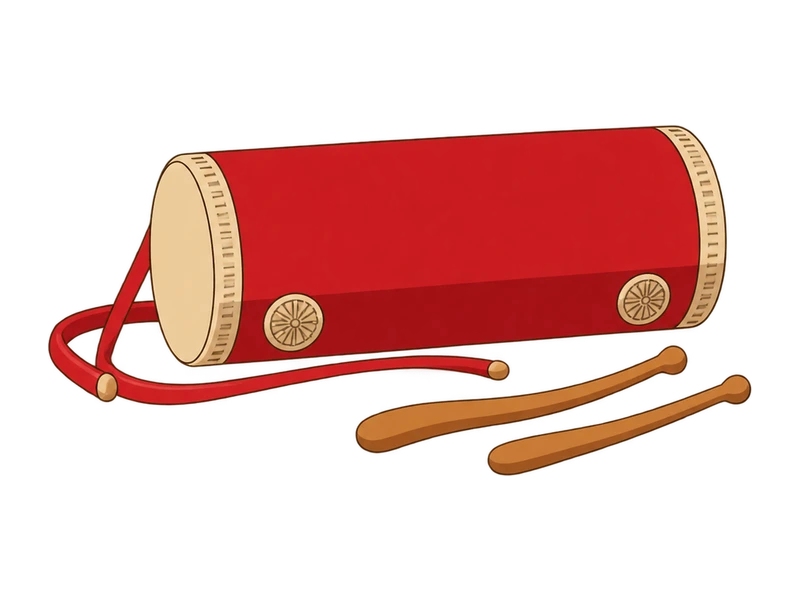
兰州太平鼓 · 筒形鼓
中国 · H-S 21
演奏与应用
兰州形制以鼓槌击奏,结合肩挎、转身与队列动作;京西形制则持框鼓击奏并配合舞蹈。网页鼓垫供体验基础节奏。
节庆鼓舞、民间仪式与舞台表演。照片所示地域形制在图下注明。
Overview
The Taipinggu (Chinese: 太平鼓; pinyin: tài píng gǔ) is a dance variety with hand-held drum; it is also known as Dangu (Chinese: 单鼓; pinyin: dān gǔ) and "Drums of Great Peace". It is popular in North China and commonly performed by the Manchu ethnic group for shamanist priests. As the years passed by, it became a way for people to express the joyfulness and happiness. The Taipinggu was originated in the Tang dynasty and prospered in Qing Dynasty, with a history of more than 2,000 years. There are two widely known kinds of Taipinggu, one is in Western Beijing and another kind is invented in Lanzhou, China.
Classification
The Jingxi Taipinggu (Chinese: 京西太平鼓; pinyin: jīng xī tài píng gǔ) is of folk dance for entertainment. With a widespread mass base and deep historical roots, it plays an important role in folk activities. Taipinggu had been popular in Western Beijing since the Ming Dynasty, and it became very popular in the early Qing Dynasty. In the late Qing Dynasty, taipinggu was spread to the Mentougou District. Almost everyone from many villages in Mentougou District was able to play the taipinggu historically. Taipinggu was played in the imperial palace on Chinese New Year's Eve, so it was also called "yingniangu (the drums played to welcome the Chinese New Year)" in Beijing. The time to play the taipinggu most is the twelfth and the first month of the lunar year. It is attractive and popular in local calendric folk customs, and people play it to express their best wishes for a time of peace and prosperity. Playing the taipinggu can not only enhance the festive atmosphere but also reflect the festive customs of Beijing area in a traditional way. Performing the Taipinggu is a symbol of the cultural identity of local people. The Lanzhou Taipinggu (Chinese: 兰州太平鼓; pinyin: lán zhōu tài píng gǔ) in Gansu Province has been long known as the "crown of drum dances" worldwide, with a history of more than 600 years. It is popular in the Chinese cities such as Lanzhou, Yongdeng, Jiuquan, Zhangye, Jingyuan, etc. Lanzhou's Taipinggu is cylinder-shaped, with drum body 70–75 cm high, drumhead 45–50 cm long in diameter, and drum weight 19–22 kg. Its upper and lower surfaces are covered by cow leather, painted with such patterns as two dragons playing with a pearl. Its strap is long enough to be hungover shoulders, facilitating percussion and helping a drummer throw it to any direction.
资料来源
Wikipedia contributors · CC BY-SA 4.0https://en.wikipedia.org/w/index.php?oldid=1269019827 · 2026-10-05 · 原文节选与分节整理。
SciForu Music · AI-assisted illustration · 图片来源https://jizhiapi.site/v1 · AI-generated illustration; provider terms apply; reference: CC0https://jizhiapi.site/ · 形制参考:Gary Todd from Xinzheng, Chinahttps://commons.wikimedia.org/wiki/File:Lanzhou_Peaceful_Drum_and_Hua_Drum_(9912623693).jpg · CC0http://creativecommons.org/publicdomain/zero/1.0/deed.en · AI 辅助 2D 乐器识别插画,透明 WebP;服务条款适用。
MIMO H-S 分类参考https://www.mimo-international.com/documents/Hornbostel%20Sachs.pdf